

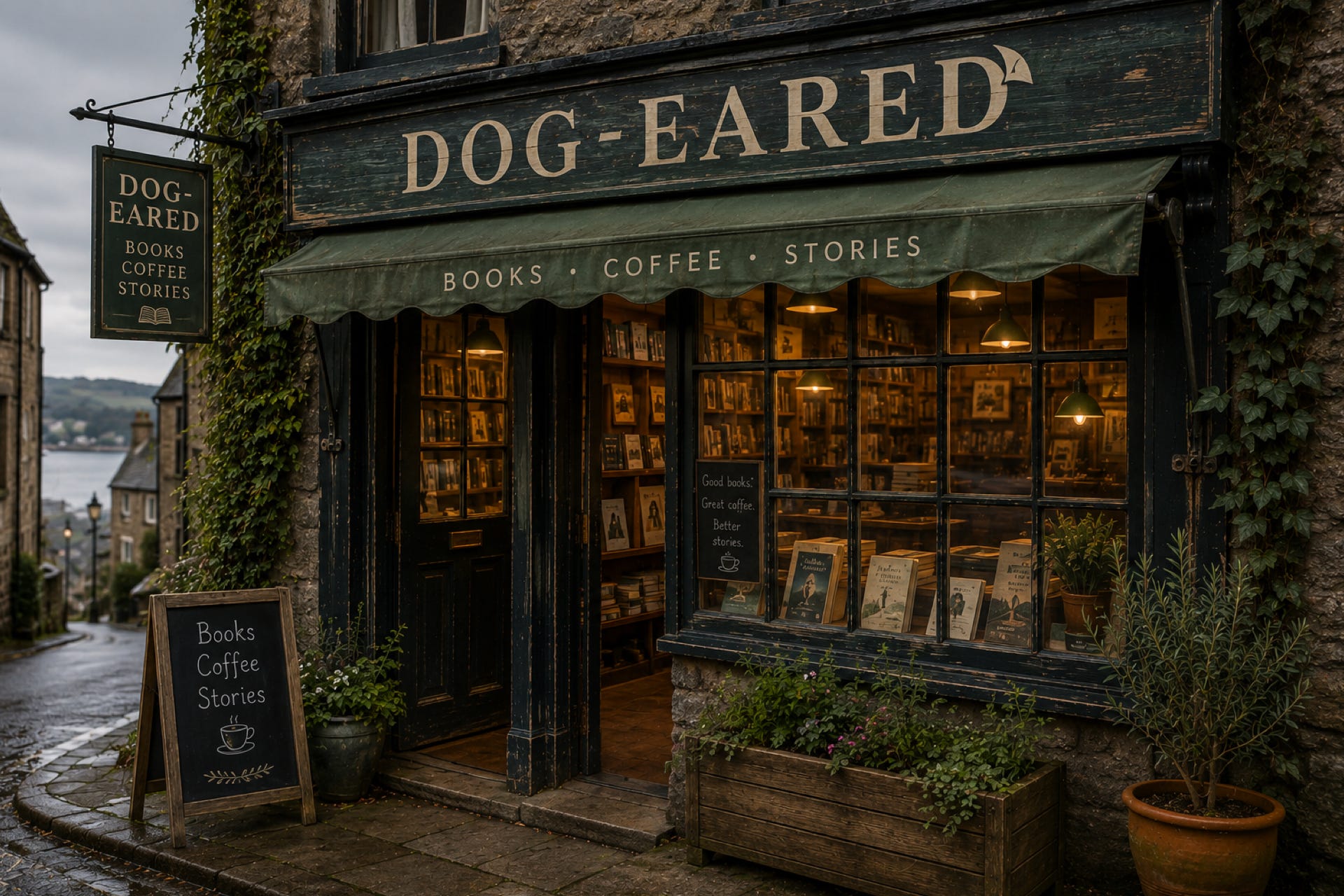
The coffee shop knew her as the woman who didn’t drink coffee.
George knew her as Anna.
Every Saturday, just after ten, Anna pushed open the door beneath the faded green awning, shook the weather from her coat and ordered a pot of English Breakfast tea in a room where the smell of roasted coffee, old paper and rain-damp coats competed for attention.
George had been trying to convert her for six years. He’d simply accepted defeat a few months ago.
“Tea?” he asked that morning, already reaching for the small white pot beneath the counter.
“You say that as though I might have developed a personality since last week.”
“I live in hope.”
“Dangerous habit.”
“So I’ve heard.”
He smiled and added a second teabag without being asked.
The café occupied the back half of an independent bookshop called Dog-Eared, a narrow, slightly crooked place where the shelves leaned towards one another like old friends sharing gossip. Every surface seemed to hold books: stacked beneath tables, arranged along windowsills, balanced on top of radiators that had not worked properly since 1998.
Anna loved it entirely.
She loved the brass bell above the door and the mismatched chairs. She loved the handwritten staff recommendations and the old wooden staircase that complained beneath every footstep. She even loved the fact that the toilet door only locked if you lifted it slightly and turned the handle at the same time.
Mostly, she loved the smell.
Paper, dust, tea and other people’s lives.
She carried her tray to the little table beside the travel section. It had never officially belonged to her, but after six years of occupying it most Saturday mornings, ownership had begun to feel like a technicality.
On the table, she placed her tea, a fountain pen, a roll of brown paper, a length of string and a well-read paperback.
The book’s spine was creased almost white. Its corners had softened with use, and several pages had begun to loosen from the binding. She had bought newer copies over the years, but none of them felt like this one.
This one had travelled with her through three houses, one marriage and a divorce.
She rested her hand over the title.
The Bridges of Madison County.
It was not a book she recommended lightly.
Mentioning it often invited one of two reactions. People either sighed dreamily or announced that they could never look past the affair, as though moral certainty were a competition and the quickest answer won.
She understood the objection.
She shared it, in many ways.
Infidelity did not become noble simply because it was described beautifully. Pain did not disappear because the people causing it had also been lonely.
But that was not why she loved the book.
She loved it because it understood how quietly a person could vanish inside their own life.
How a woman could fulfil every role asked of her and still feel unseen.
How routine could become a kind of anaesthetic.
How being wanted was not always the same as being known.
And how something could be wrong, brief and impossible, yet still reveal a truth that had been waiting years to be noticed.
That was harder to explain at dinner parties.
She poured her tea and watched steam cloud the lenses of her glasses.
The idea had come to her three weeks earlier, somewhere between deleting a dating app and deciding she would rather eat dry cereal for dinner than answer another message beginning with Hey gorgeous.
It was not that she had given up on people.
That sounded too final.
She had simply grown tired of the order in which people were expected to discover one another.
Photograph first.
Job title second.
Age, height, location.
A few rehearsed facts arranged neatly enough to resemble a person.
Only later, if at all, came the things that actually mattered.
How someone behaved when they were disappointed.
Whether they noticed when another person went quiet.
What they believed loyalty meant.
Which books had broken them.
Whether they could disagree without trying to win.
She wanted to reverse the process.
Not forever.
Just once.
As an experiment.
She opened the book.
For the past week, she had been writing inside it.
Nothing that obscured the printed words. Nothing grand enough to look staged. Just small notes in pencil, scattered through the margins like fragments of an overheard conversation.
Beside one passage, she had written:
This was where I stopped judging her and started understanding her.
Several pages later:
I don’t think loneliness excuses betrayal. I do think it explains why people sometimes become strangers to themselves.
Near the end:
Perhaps some love stories are not meant to become lives. Perhaps they exist only long enough to wake us up.
She had paused over that one.
Then left it.
The notes were not an argument.
They were an invitation.
A stranger might read them and agree.
They might dislike them.
They might abandon the book after twenty pages and return it to the shelf.
Any of those outcomes would be fair.
The experiment only worked if the choice remained theirs.
She turned to the inside cover, where a folded piece of cream paper had been fixed carefully with two small strips of archival tape.
She read the note again.
Dear Stranger,
If this book found you when you needed it, I hope whatever you’re carrying becomes a little lighter.
This is one of my favourite novels, although perhaps not for the reasons you might expect.
I don’t need you to admire every choice made inside it. I don’t.
I only ask that you finish it before deciding what you think it means.
You may notice a few thoughts in the margins. They are mine, though I’ve left my name out of them deliberately.
If you reach the final page and feel no curiosity about the person who wrote them, place this book back on the community shelf. No offence will be taken. I will never know.
But if you do feel curious, ask at the counter for The Saturday Journal.
There are no promises inside it.
Only questions.
She read it twice, then folded the paper back into place.
Her heart had begun beating with an enthusiasm entirely disproportionate to the situation.
“This is ridiculous,” she whispered.
The student at the next table glanced up from a laptop.
She pretended to be discussing the book.
George appeared beside her carrying a small plate.
“You look like someone plotting a murder.”
She looked down at the slice of lemon drizzle cake.
“I didn’t order this.”
“You’re the only person in Cornwall who comes to a coffee shop every week and refuses to drink coffee. I feel responsible for keeping you interesting.”
“I’m conducting a social experiment.”
He looked at the brown paper, the string and the battered paperback.
“Is the experiment whether anyone can wrap a parcel using only spite?”
“I haven’t started yet.”
“Exactly.”
She gave him a look.
He sat in the empty chair opposite her without invitation, which was one of the reasons she liked him.
“What are you doing?”
She hesitated.
George owned the café with his sister, who owned the bookshop. Between them, they knew almost everything that happened beneath the green awning. They had witnessed first dates, break-ups, job interviews, panic attacks, proposals and one memorable incident involving a poetry reading and a collapsed bookshelf.
If she trusted anyone with this, it was probably them.
She reached beneath the table and lifted a second object from her bag.
A hardback journal bound in deep blue cloth.
The pages were thick and unlined. A narrow ribbon ran down the centre, and the cover was completely plain.
George looked from the journal to the paperback.
“This is getting sinister.”
“I need you to keep this behind the counter.”
“Evidence?”
“Possibly.”
She opened the journal to the inside cover and passed it across the table.
She had written the rules there the night before.
The Rules
1. No names.
Not yet.
2. No descriptions of appearance.
Let words make the first impression.
3. Tell the truth.
Not every truth. Only the ones you choose to offer.
4. Questions are welcome.
Interrogations are not.
5. Do not ask to meet.
If that ever happens, it should be because both people choose it.
6. Return the journal to Dog-Eared within seven days.
Leave it behind the counter for the other person.
7. Be kind.
Honesty does not require cruelty.
George read the page slowly.
When he finished, he looked at her over the top of the journal.
“So this is a dating scheme.”
“It is not a dating scheme.”
“You’re hiding a secret notebook behind my till and baiting strangers with tragic romance.”
“When you phrase it like that, it sounds unhinged.”
“I’m not sure there’s another way to phrase it.”
She took a sip of tea.
“It’s an experiment.”
“In what?”
She looked towards the front of the shop.
A man in a raincoat stood reading the back of a crime novel. An elderly woman was rearranging the contents of her handbag. A little boy sat cross-legged on the floor while his father read aloud from a picture book about a bear.
“In whether we might know people better if we met their minds before their faces.”
George’s expression softened.
Only slightly.
“And what happens if nobody asks for the journal?”
“Then nobody asks.”
“You’ll be disappointed.”
“Probably.”
“And if someone does?”
She looked down at the blue cover between them.
“Then I write back.”
George tapped the rules with one finger.
“And I’m supposed to hand this over to anyone who asks?”
“Only if they use the exact name.”
“The Saturday Journal.”
“Yes.”
“And when they return it?”
“You put it back behind the counter and tell me the following Saturday.”
“You realise I’ll know who they are.”
“You’ll know what they look like.”
“Same thing, apparently.”
“Not according to the rules.”
He laughed quietly.
“You’ve thought about this far too much.”
“I’ve thought about almost everything far too much.”
“That,” he said, standing, “I believe.”
He took the journal with him.
At the counter, he placed it on the highest shelf beneath a stack of order forms, out of sight from the café.
Her pulse shifted strangely at the sight of it disappearing.
Until then, the experiment had existed only in her imagination.
Now it was waiting for someone.
She turned her attention to the paperback.
Wrapping it proved more difficult than expected. The paper creased in the wrong places. The string slipped twice. The first bow looked as though it had been tied during an earthquake.
George watched from behind the counter, saying nothing.
She gave him a warning look.
He raised both hands.
Eventually, the book sat before her in brown paper, imperfect but presentable.
On the front, she had written:
BLIND DATE WITH A BOOK
A short, bittersweet story about timing, loneliness and the dangerous relief of being truly seen.
For readers who believe something can be morally complicated and emotionally true.
Please return me to the community shelf when you’re finished.
She stared at the final sentence.
Then added, in smaller writing:
Unless the margins make you curious.
That felt too obvious.
She crossed it out.
The paper now carried a black line across its centre.
Perfect.
She almost laughed.
The entire experiment rested on mystery, and she had nearly spoiled it because she could not resist explaining herself.
Some habits followed a person everywhere.
She finished her tea, wrapped the remaining cake in a napkin and gathered her things.
The community shelf stood beside the front window beneath a hand-painted sign:
TAKE A BOOK. LEAVE A BOOK. PASS A STORY ON.
It held a chaotic mixture of crime novels, cookbooks, celebrity memoirs and romantic paperbacks with men on the covers who appeared to have misplaced most of their shirts.
She placed the wrapped book in the centre.
It looked conspicuous among the exposed spines.
Deliberate.
Waiting.
For a moment, she imagined the kind of person who might choose it.
A woman looking for something short to read on the train.
A retired teacher.
A teenager hiding from the rain.
A man who hated love stories and picked it up by mistake.
Perhaps nobody.
That remained the most likely outcome.
She tucked her hair behind her ear and stepped back.
George was polishing a cup behind the counter.
“You can still change your mind,” he said.
“I know.”
“You could take it home and download a dating app like a normal person.”
“I’d rather eat the book.”
“Fair.”
She slipped on her coat.
The rain had eased into a grey mist beyond the window.
At the door, she turned.
The wrapped book remained exactly where she had left it.
Of course it did.
She had placed it there less than a minute ago.
Still, disappointment moved through her so quickly that she almost laughed at herself.
This was the trouble with hope.
It could make an empty shelf feel personal.
She opened the door.
The brass bell chimed above her head, and cold air slipped into the shop.
“Next Saturday?” George called.
“As always.”
“Coffee?”
“Don’t be ridiculous.”
She stepped onto the pavement and pulled her coat closed.
Behind her, the bell rang again.
A man entered the shop as she walked away.
She did not turn around.
Had she done so, she might have seen him pause beside the community shelf while George prepared an Americano for someone else.
She might have watched him scan the handwritten description on the brown paper.
She might have noticed the brief, sceptical lift of his eyebrow at the words morally complicated.
Instead, she kept walking through the mist.
Inside Dog-Eared, the stranger picked up the book.
He turned it over once in his hands.
Then carried it to the counter.