

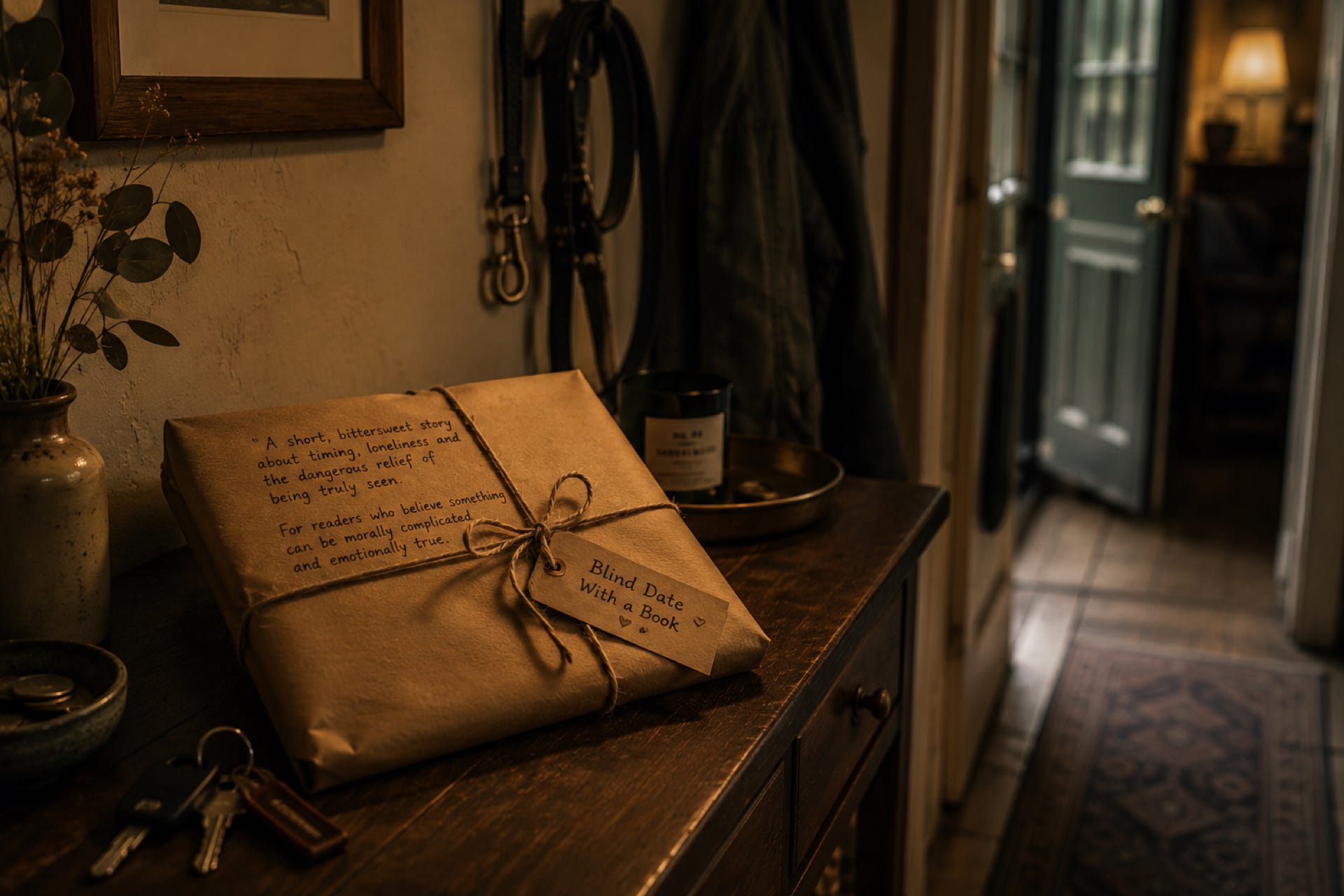
The book spent most of Saturday being ignored. For several hours it sat on the passenger seat of his car, sliding gently against the door whenever he took a corner too quickly.
He noticed it twice. Once while throwing his coat across the seat. Once when a sharp turn sent it flying into the passenger footwell. Neither occasion inspired him to open it. This was not personal.
He had picked it up that morning because the description on the brown paper had irritated him just enough to be interesting.
A short, bittersweet story about timing, loneliness and the dangerous relief of being truly seen.
That sounded suspiciously like the sort of sentence people wrote when they wanted to make bad decisions sound profound.
Then there had been the next line.
For readers who believe something can be morally complicated and emotionally true.
He had raised an eyebrow at that. Still, he had taken the book. Curiosity had a habit of leading him slightly off course.
By the time he finally arrived home, however, the parcel had been forgotten beneath his coat and his attention was elsewhere. He had a first date in just over an hour.
He had barely got the key into the front door when something hit it from the other side. He stopped. There was a thud. Then another. Then the unmistakable sound of claws scrabbling against wood.
“Clem.”
A muffled whine answered him.
“You are making this considerably harder.”
The tail began before he had fully opened the door. It struck the hallway wall. The umbrella stand. The wall again. Then thirty kilos of chocolate Labrador launched herself at him as though he had returned from war rather than a day out.
“Down.”
Clem did not get down.
“You saw me this morning.”
She attempted to lick his chin.
“Eight hours, Clem.”
Her paws slid down his body. For approximately two seconds she remained on the floor. Then excitement overcame both memory and training and she jumped up again.
“Clementine.”
That produced a pause.
She knew her full name. She also knew it generally meant that whatever she was doing had ceased to be charming.
She sat but her entire body continued wagging.
“Thank you.”
Clem sneezed.
“Quite.”
He stepped inside and closed the door. She immediately pushed her head beneath his hand. There was something impressive about a creature capable of experiencing the same reunion every single day as though previous reunions had never happened. He scratched behind her ears.
“Yes. Devastating. I left you with food, water, central heating and unrestricted access to a sofa you’re not technically allowed on.”
Clem leaned her entire weight against his legs. He nearly lost his balance.
“Personal space continues to elude you, apparently.”
He went back to the car for his coat. The parcel fell out when he opened the passenger door. He picked it up, carried it inside and dropped it onto the little table in the hallway beneath his keys.
Clem’s nose appeared immediately.
“No.”
Sniff.
“It’s a book.”
More sniffing.
“There’s nothing edible in it.”
Clem looked unconvinced.
“Not everything that comes wrapped in paper is food.”
Her nose returned to the parcel.
“You’re a Labrador. I realise that’s a difficult concept.”
His phone vibrated. He pulled it from his pocket.
7:30 still good? x
He checked the time. 6:21pm. Plenty of time. Probably.
He typed:
Absolutely. See you there x
Then stared at it. Deleted the kiss. Looked at the message again. Without the kiss, it appeared oddly formal. He put it back. Then wondered whether putting one kiss when she had sent one kiss looked calculated. He considered two. Two was deranged. He returned to one. Dating, he thought, had somehow reduced otherwise functional adults to conducting forensic analysis on punctuation. He pressed send and then looked down at Clem.
“Where’s your lead?”
For half a second, nothing happened. Then Clementine lost her mind. She spun in a circle, skidded across the hallway floor, recovered badly, ran towards the kitchen for reasons known only to herself, changed her mind halfway there and came charging back. Her tail hit the umbrella stand. The umbrella stand hit the wall.
“Excellent. Very calm.”
Clem sneezed.
“Go on, then. Find it.”
She disappeared. He heard something fall over in the next room.
“That’s reassuring.”
Half an hour later, he was standing in front of his wardrobe in a towel while Clem lay across the bedroom doorway. He held up two shirts.
“Blue or white?”
Clem yawned.
“Strong opinion.”
He chose blue.
Clem got onto the bed.
“You’re not allowed up there.”
She turned in a circle.
“Clem.”
She lay down. Then, with the complete confidence of someone who contributed nothing towards the mortgage, lowered her head onto his pillow. He looked at her.
“Comfortable?”
Her tail thumped once and he tutted.
His phone was beside her, the dating app still open. He retrieved it before she could lie on that too.
Sophie.
Thirty-eight.
Marketing.
Liked live music, Sunday roasts, travelling somewhere new at least once a year, and people who did not take themselves too seriously.
There were six photographs. He knew she had brown hair. He knew she was five foot six. He knew she had climbed a mountain in Peru because one photograph showed her standing at the top of one. He knew she disliked coriander. He knew she was looking for something meaningful but not forced.
He had no idea what that meant. Presumably Sophie did. He swiped through her photographs once more. Then locked his phone.
Clem had closed her eyes. He finished buttoning his shirt. On his way downstairs, he passed the brown-paper parcel.
He didn’t give it a second thought as he slipped his keys into his pocket. The bar was less than a fifteen-minute walk away, and while ‘five and drive’ was a theory he’d heard echoed around enough pubs over the years, it had never been his style.
He called goodbye to Clem and headed out on foot.
Sophie was nicer than he had expected. He realised almost immediately that this was an unfair thing to have considered. She was already sitting at a small table near the window when he arrived. She stood when she saw him.
There was that strange half-second of recognition peculiar to dating apps: encountering someone for the first time while simultaneously knowing exactly what they looked like.
“Hi.”
“Hi.”
They hugged. Not quite strangers. Not remotely acquaintances. Something invented by technology in between.
“You made it,” she said.
“Eventually.”
“You’re two minutes late.”
“I was hoping you wouldn’t notice.”
“I notice everything.”
“That sounds ominous.”
“It was meant to.”
He laughed. That helped. The first ten minutes were easy. So were the next twenty. They ordered drinks. They talked about work. Sophie told him about a colleague who had accidentally sent a message complaining about their manager directly to the manager. He told her about the time Clem had eaten an entire white-chocolate Toblerone.
“An entire one?”
“Silver wrapper and all.”
“Oh my God! Was she all right?”
“She was utterly delighted. Me, less so. For the next forty-eight hours I was picking up dog shit that glittered in the sunlight.”
Sophie giggled and then stared at him thoughtfully as he took a sip of his drink.
“Like the world’s least festive Christmas decoration.”
He laughed, screwing up his face as the memory seemed to invade his senses all over again.
She laughed hard enough to put her glass down. He liked her laugh.
“So what does Clem stand for?”
“Clementine.”
“Oh, that’s gorgeous.”
“It wasn’t my decision.”
“Ex?”
He looked at her.
“Is it that obvious?”
“Men don’t generally name their dog Clementine.”
“That’s an outrageous generalisation.”
“Did you?”
“No.”
She smiled into her glass.
“My case rests.”
He found himself smiling too.
“Film character,” he said.
“Really?”
“Eternal Sunshine of the Spotless Mind. Her favourite film.”
“And Clem stayed with you?”
He took another sip of his drink.
“Clem decided that.”
Something in his tone must have closed the subject because Sophie didn’t ask what he meant. He appreciated her for that. The date continued. And continued well. There was nothing wrong with Sophie. At least nothing yet. No obvious incompatibility. No appalling opinions. No photographs taken fifteen years earlier.
She was funny. Attractive. Interested.
And, he decided, he was interested in her. Probably.
“So,” she said eventually, turning the stem of her wine glass between her fingers, “how long have you been doing this?”
“This particular drink?”
“No! Dating apps,” she snorted.
“Ah.”
“Sorry. Are we not supposed to acknowledge where we came from?”
“I think we’re meant to tell people we met in a library.”
“More romantic.”
“Considerably.”
“Although I’d never meet anyone in a library.”
“No?”
“You can’t tell anything about someone in a library.”
For no particular reason, he thought of the parcel on his hallway table.
“No,” he said. “I suppose you can’t. About a year,” he added. “On and off.”
“Same.”
“And?”
“And what?”
“Have you reached any conclusions?”
“Yes.”
He waited.
“I hate first dates.”
He laughed.
“That doesn’t bode particularly well.”
“Not you.”
“Comforting.”
“This bit.”
She gestured vaguely between them.
“What bit?”
“The interview.”
He smiled.
“Tell me about your job. Where did you grow up? Brothers and sisters? Last relationship? Any unexplained criminal convictions?”
“Obviously that one comes with dessert.”
“Obviously.”
She laughed. Then her expression changed. Not sadness. Something closer to recognition.
“It’s weird, isn’t it?”
“What is?”
“Well, we already know loads about each other, don’t we.”
“Do we?”
“Well. I know what you do. Roughly where you live. Your age. I’ve seen you on holiday.”
“You’ve seen six carefully selected photographs intended to imply I occasionally leave the house.”
“I’ve seen you holding a fish.”
“That photograph was taken under duress.”
“You looked very pleased with yourself.”
“I was drunk.”
“See? Now I’m getting to know you.”
He smiled.
“And I’ve seen you on a mountain.”
“That was four years ago.”
“I feel deceived.”
“You should. I haven’t climbed anything since.”
He laughed. She took a sip of wine.
“But that’s the strange bit, isn’t it?”
“What?”
“I knew what your face looked like before I knew what your voice sounded like.”
He looked at her and she shrugged.
“I knew your job before I knew whether you were kind to waiters.”
“Am I?”
“You said thank you when he brought the napkins.”
“Low bar.”
“You’d be surprised.”
He smiled.
Then she said, “But none of it means I know you.”
The sentence settled between them.
“No. And I don’t know you yet.”
For a moment neither of them spoke. Then Sophie grimaced.
“Sorry. I’ve made it weird.”
“I don’t mind weird.”
“That’s lucky.”
She raised her glass.
“To discovering whether either of us is secretly unbearable.”
He touched his glass to hers.
“Give it time.”
The date lasted another hour or so. There was a second drink. And a third. More laughter too, before he eventually settled the bill. They made their way outside. Beneath the streetlights, they hugged again. This one was easier.
“I had a nice time,” Sophie said.
“So did I.”
It was true.
“We should do it again.”
There was the smallest pause. Not enough to mean anything. But enough to notice.
“Yeah,” he said. “We should.”
She smiled.
“Goodnight.”
“Night.”
He watched her step into a taxi, shoved his hands into his pockets and started the walk home.
He’d had a good time. Sophie was funny, easy to talk to, and he liked the way her whole face lit up when she laughed. He wondered if she would text. He hoped she would.
Clementine was waiting behind the door. Of course she was. Her tail began the moment his key touched the lock.
He opened the door.
“Don’t.”
Clem jumped.
“Clementine.”
She dropped back to the floor and immediately pushed her head into his stomach.
“I’ve been gone all of three hours.”
Her tail hammered the wall.
“You’d have thought I’d emigrated.”
Clem pushed closer. He rubbed both hands vigorously over her ears.
“Yes, hello. Terrible ordeal. Nobody has ever suffered as you have.”
He took off his coat and replaced his keys on top of the parcel as he passed the hallway table. The house was quiet as he moved towards the kitchen. Not silent. The refrigerator hummed. A car passed outside. Clem’s nails clicked against the floor as she followed him from room to room, apparently concerned that he might disappear again if left unsupervised. He filled a glass from the cold tap and took a long drink.
His phone buzzed.
Home safe. Thank you for tonight x
He looked at the message.
Typed:
Me too. Had a really nice time x
He stared at it. Deleted really. Read it again. Put really back.
“This is absurd.”
Clem was drinking from her bowl. She offered no guidance. So he sent it and then slipped his phone into his pocket.
Sophie had been nice. More than nice. He would probably see her again. He should see her again. There was no reason not to.
That, he thought, was perhaps the least romantic reason to see somebody again that had ever existed.
He carried his glass into the hallway. His keys were where he had left them. Beneath them sat the parcel. He picked it up.
BLIND DATE WITH A BOOK
He stared at the words.
“Oh, apparently we’re making an evening of it.”
Clem appeared. Her nose went immediately to the paper.
“No.”
She sniffed harder.
“Still not food.”
He carried the parcel into the sitting room and sat down. Clem jumped onto the sofa beside him.
“You’re not allowed up here either.”
She turned in a circle and collapsed against his thigh. He looked at her. She closed her eyes.
“Fine.”
He read the description again.
A short, bittersweet story about timing, loneliness and the dangerous relief of being truly seen.
Still irritating.
Then:
For readers who believe something can be morally complicated and emotionally true.
He frowned.
“Still sounds suspicious.”
Clem’s tail tapped the cushion.
“Exactly.”
He untied the string. Or tried to. The knot tightened. He pulled at it a little. Nothing.
Whoever wrapped this was either angry or sadistic. Eventually he slid the string from one end and unfolded the paper. The cover appeared. He stared at it. There was a pause.
“Oh, for fuck’s sake!”
The Bridges of Madison County.
He knew enough about it to know there was an affair. That was approximately everything he knew. Years ago, someone had made him watch part of the film.
He remembered rain.
Clint Eastwood.
A kitchen.
And thinking that several people’s lives might have been considerably improved by a straightforward conversation.
He turned the book over. Then back again.
“This is what happens when you choose books based on anonymous emotional blackmail,” he explained to Clem.
Clem was asleep.
“Excellent support.”
He was about to put it on the coffee table when he noticed the cream paper fixed inside the cover. He opened it.
Dear Stranger,
He began reading with the same mild scepticism he’d given the wrapper.
I don’t need you to admire every choice made inside it. I don’t.
He straightened slightly in his seat and continued reading.
I only ask that you finish it before deciding what you think it means.
“That’s quite a demand.”
Clem opened one eye.
He read on.
If you reach the final page and feel no curiosity about the person who wrote them, place this book back on the community shelf. No offence will be taken. I will never know.
Something about that interested him. Not the invitation. The absence of pressure. Whoever had written this genuinely appeared prepared never to know what happened next. Then he reached the final lines.
But if you do feel curious, ask at the counter for The Saturday Journal.
There are no promises inside it.
Only questions.
He read the last two words again.
Only questions.
He turned the paper over. Blank. No name. No number. No social-media handle. Nothing.
He realised, with some amusement, that he didn’t even know whether the person who had written it was a woman.
He had assumed.
Why?
The handwriting, perhaps. The book. The slightly earnest description on the wrapper. None of which proved anything.
He removed his phone from his pocket. Sophie existed inside it in six photographs and a collection of facts:
Brown hair.
Thirty-eight.
Marketing.
Peru.
No coriander.
He knew considerably less about the person who had written this note. He didn’t know their age. Their face. Their voice. Their job. Whether they were married. Whether they were lonely. Whether they were interesting. Whether they were completely insufferable.
And yet—
“No.”
Clem lifted her head, knocking the note from his hand. He picked it up and replaced it in the book. Then noticed the pencil writing in the margin.
This was where I stopped judging her and started understanding her.
He read the printed passage beside it. Then the note again. He disagreed. Quite strongly.
“That’s convenient,” he said aloud.
Clem sighed. He turned the page. Then another. Nothing. He flicked forward. More handwriting:
I don’t think loneliness excuses betrayal. I do think it explains why people sometimes become strangers to themselves.
He stopped. Read it once. Then again. His first instinct was to object. Explanations were dangerous things. People had a habit of turning them into permissions. His eyes remained locked to the end of the second sentence.
Strangers to themselves.
He reached towards the side table. Nothing. He opened the drawer. Receipts. A phone charger. Two batteries. And a pencil. He picked it up. Then stopped himself before committing graphite to paper.
“What am I doing?”
Clem’s eyes opened. He looked at the margin. There was room beneath the handwriting. More than enough for a reply. He touched the pencil to the paper. Then pulled it away.
“No.”
He put the pencil down. Closed the book and placed it on the coffee table.
His phone buzzed. A message from Sophie:
I’d like to see you again :)
He smiled. Not reluctantly. Not falsely. A real smile.
He typed:
I’d like that too :)
And he meant it. He sent the message and replaced his phone on the table, face down.
The book also remained on the table. He looked at it. Clem looked at him.
“No,” he protested. “It’s bedtime.”
Clem rolled onto her back, making it difficult for him to get up. Defeated, he picked up the book.
“One chapter.”
Clem stretched across the space beside him.
“One.”
He opened to the first page.
Outside, rain began tapping softly against the window. Clementine slept beside him, one paw twitching occasionally in a dream. His phone remained face down on the table. The pencil lay untouched beside it, while the stranger in the margins continued arguing with him without knowing he existed.
By the time he noticed, the rain had stopped and he was three chapters in.