

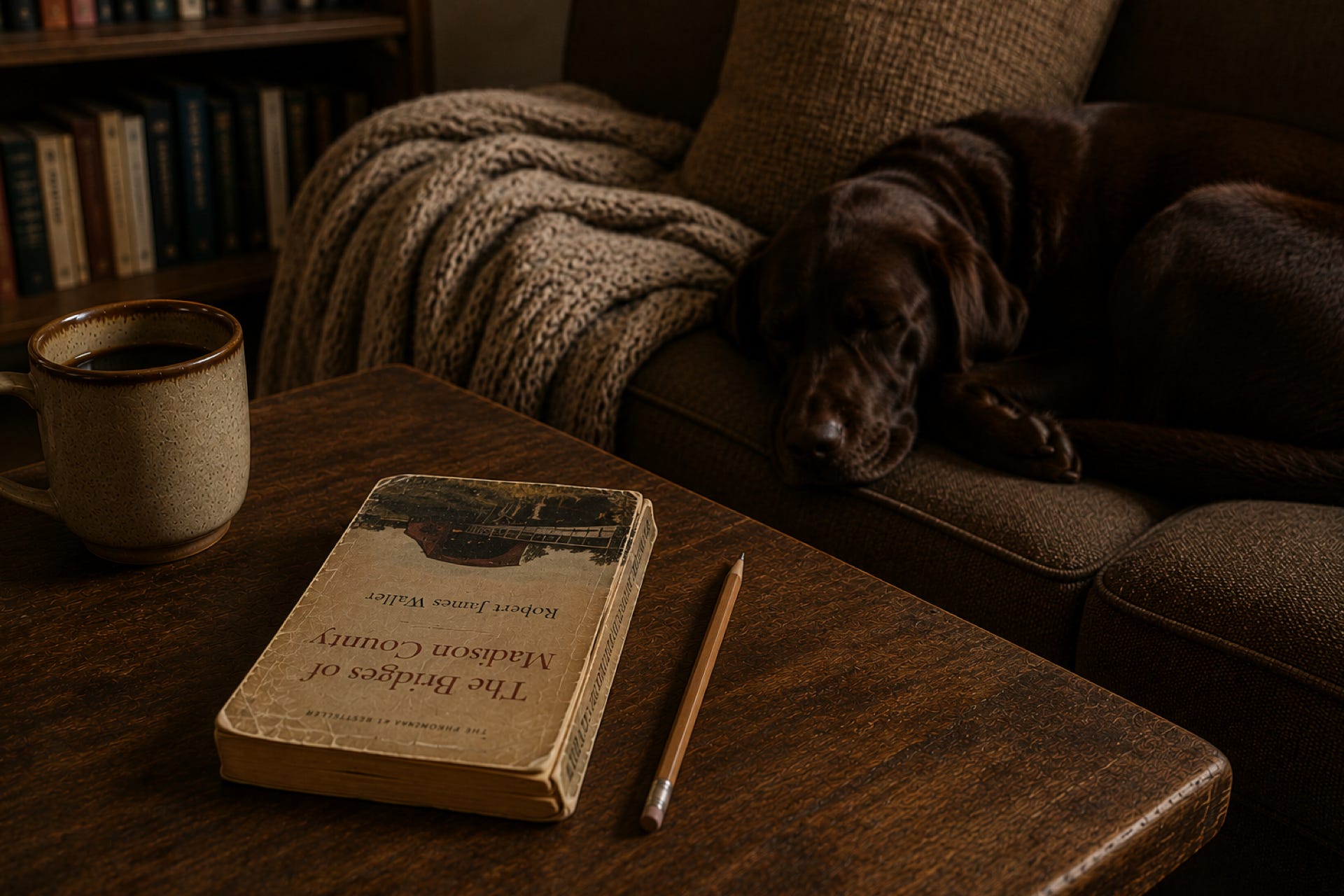
He woke on Sunday morning with a Labrador’s nose pressed against his face.
For several seconds, he remained perfectly still. Clementine breathed on him.
He opened one eye.
“No.”
Her tail began hitting the duvet.
“No.”
The tail accelerated.
“Absolutely not.”
Clem licked his nose.
“Oh, for God’s sake.”
He rolled away, pulling the duvet over his head. This achieved nothing. Clementine simply climbed further onto the bed and began investigating the small gap between the pillow and his shoulder.
“You have an entire house.”
Sniff.
“Several perfectly good places to sleep.”
Sniff.
“Your own bed, for example.”
The duvet lifted as a wet nose forced its way underneath.
“You’re unbearable.”
Clem sneezed directly into his neck.
He sat up.
“Fine.”
She launched herself from the bed and ran from the room.
He checked the time.
8:17.
“Traitor.”
From downstairs came the unmistakable sound of a food bowl being pushed enthusiastically across the kitchen floor.
He got dressed.
The book was still on the coffee table when he returned from walking Clem, damp around the shoulders and carrying a paper bag from the bakery. It sat exactly where he had left it. Pencil beside it. He looked at the book. Then at the pencil. Then went into the kitchen.
Clem followed.
“You need to stop assuming everything concerns you.”
She sat beside the cupboard containing her food.
“You’ve eaten.”
She continued staring at him.
“You ate forty minutes ago.”
Nothing.
“You have the short-term memory of a goldfish.”
He reached for one of her meaty treats before making himself a coffee. Clem snapped to attention, then offered him a paw with impressive politeness before taking the treat from his fingers. He flicked the drool from his hand and tore off a piece of the croissant he’d bought, leaning against the counter as he ate.
His phone buzzed. It was Sophie.
Morning :) Hope Clem allowed you a lie-in. I’m beginning to suspect I was the third wheel last night x
He smiled.
You have no idea. Woke up with her nose approximately 2mm from my eyeball x
The typing bubble appeared almost immediately.
Jealous. Most men make you wait until at least the third date for that kind of intimacy.
He laughed.
Clem looked up, licking her lips.
“She’s funny.”
Clem’s attention returned to the possibility of more food.
He typed:
Speaking of third dates, are we skipping the second?
Three dots.
Absolutely not. I need more information before I commit to that level of Labrador involvement.
He smiled again.
Good.
Then, before he could decide whether to suggest somewhere:
I know a place. Thursday?
He looked at the message.
Thursday works x
A moment later:
I’ll send you the details x
He put his phone down. That was good. Simple. Normal.
He picked up his coffee and went into the sitting room.
The book was waiting.
Not literally, of course. But there was something about it now - the unread pages, the pencil marks, the stranger somewhere behind them - that quietly demanded his attention despite his determination not to give it.
He sat down. Clem jumped onto the sofa beside him.
“You’re developing some very concerning habits.”
She rested her head on his thigh. He picked up The Bridges of Madison County.
“One chapter.”
Clem closed her eyes as she had the night before. He found his place.
Twenty minutes later, he encountered the next piece of handwriting. It sat quietly in the margin beside a passage he had just read.
This was where I stopped judging her and started understanding her.
He frowned. He had seen the note the night before when flicking through the pages, but reading it where it belonged was different.
He went back over the paragraph. Then the note. Then the paragraph again.
“No.”
Clem opened one eye.
“Still no.”
Understanding was all well and good. Understanding was easy from a distance, when nobody had to live with the consequences.
He looked at the handwriting again. Neat, but not especially so. The final word sloped slightly towards the edge of the page as though its writer had nearly run out of room.
He reached for the pencil. Then stopped.
This wasn’t his book. Of course, technically, it wasn’t hers either. It belonged to the community shelf. But writing in somebody else’s book felt vaguely criminal. Although somebody else had already started it.
He rested the pencil against his thumb.
“This is ridiculous.”
Clem sighed.
“I agree.”
He lowered the pencil to the page. Beneath the stranger’s sentence, he wrote:
Understanding someone doesn’t make what they do less selfish.
He looked at it. There. He had done it. He felt unexpectedly self-conscious. Which was absurd. The person who had written the original note was not there. They might never see his response. For all he knew, the book would be picked up next by someone who used his argument to level a wobbly table.
Still, his handwriting looked strangely exposed beneath hers. He considered rubbing it out. Instead, he turned the page.
The book went to work with him on Monday. Not deliberately. At least that was what he told himself. He had put it in his bag because he had read another thirty pages the previous day and leaving it on the sofa seemed…
He wasn’t sure what it seemed. So he took it. At lunchtime, he read seven pages. On Tuesday, twelve. On Wednesday, he opened it while waiting in the car for an appointment and realised, several minutes later, that he had been flicking forward rather than reading. Looking for pencil. He stopped. Turned back. Read the page properly.
Three pages later, there it was.
Do we owe the people we love every version of ourselves? Even the ones we don’t understand yet?
He stared at the sentence. It wasn’t attached to anything particularly dramatic. He was beginning to realise that was often where she chose to write. Not beside the grand declarations or obvious heartbreaks, but in the quieter places. Some of her notes were little more than reactions.
Oh, Francesca.
Another:
This made me angry the first time. It still does.
And, beside a description of an ordinary domestic moment:
Sometimes I think this is the saddest part of the whole book.
He had read the paragraph twice trying to understand why.
Eventually, underneath, he wrote:
Why?
One singular word. A whole question. He stared at it. There was something faintly ridiculous about asking a question of someone who wasn’t there. He closed the book. Then opened it again.
He had begun to recognise her. Not her, exactly. The shape of her thoughts. She was more forgiving than he was. Or perhaps simply more interested in why people failed.
She seemed suspicious of certainty.
She disliked easy villains. Or perhaps she simply didn’t believe in them. Whenever the book offered her someone to blame, she seemed more interested in understanding how they had got there. Not absolving them. That distinction appeared to matter to her. She could condemn what someone had done without deciding it was everything they were.
He wasn’t sure he agreed. He wasn’t sure he didn’t. She had a tendency to write questions she did not answer. And she underlined very little, which he appreciated.
People who underlined entire paragraphs had misunderstood the purpose of underlining.
He wondered how old she was. Then caught himself. That wasn’t the point. He smiled. Age wouldn’t tell him anything useful anyway.
He returned to the page.
By Wednesday evening, Sophie had sent him the name of the pub. He didn’t know it.
Apparently it was about twenty-five minutes away, tucked outside a village he had driven through dozens of times without ever having reason to stop.
Trust me, she had written.
He had replied:
That seems reckless after one date.
I live dangerously.
He checked the route. Driving meant not drinking, which suited him.
Good. You can drive me home then.
He stared at that for a moment.
Presumptuous.
Efficient.
He smiled.
Later that evening, he found the note he had already seen.
He knew it before he reached it.
I don’t think loneliness excuses betrayal. I do think it explains why people sometimes become strangers to themselves.
This time he had read enough of the novel for the sentence to irritate him properly. He sat back. Clem was asleep at the other end of the sofa, one paw twitching. He read the sentence again.
Strangers to themselves.
There was something too generous about it.
Something dangerous. People liked explanations because explanations softened edges. Give something enough context and eventually nobody had to be responsible for anything.
He picked up the pencil.
Explanations have a habit of becoming excuses when we want them badly enough.
He stopped. Read it. Then added:
Someone still has to live with what you chose.
The pencil remained against the paper. For a moment, the room seemed quieter. He looked at the sentence. Something shifted unpleasantly beneath his ribs. He put the pencil down. Clem lifted her head.
“Don’t.”
She watched him.
“I’m fine.”
Her head remained raised.
People said dogs have a sixth sense for these things. He’d always assumed that was sentimental nonsense invented by people who bought their pets birthday cards. Living with Clementine had made the theory considerably harder to dismiss.
“Honestly.”
She continued watching him. He closed the book. After a moment, Clem stood, crossed the sofa and pressed herself against his side. He scratched behind her ears.
“Subtle.”
She rested her chin on his leg. He did not reopen the book that night.
Thursday’s date with Sophie went well. Better than the first, actually.
She had chosen a small pub tucked between a church and a row of stone cottages, with low beams, a roaring fire and candles pushed into old bottles on the tables.
There was less ceremony this time. No strange half-second of recognition. No mental adjustment between photographs and person.
Just Sophie.
They ate. They talked. She stole chips from his plate despite having an identical portion of her own. He objected, of course, describing this as a boundary issue.
She made him laugh.
At the end of the evening, he drove her home.
“So, are we doing this again?”
There was no pause this time.
“Yeah.”
She smiled.
“Good.”
She kissed his cheek before getting out of the car.
He watched until she was inside.
He liked her.
There was no probably attached to it now.
He liked Sophie.
He finished it on Friday night. Clem was asleep beside him. His phone lay on the arm of the sofa. The house had gone quiet around them.
He read the final pages slowly. Not because he wanted to prolong them. He told himself that twice. When he reached the end, he closed the book. For several minutes, he did nothing.
“Well.”
Clem continued sleeping.
He looked at the cover. He still didn’t approve. That hadn’t changed. He wasn’t even sure he liked it. But the book had done something more irritating than convince him.
It had complicated him.
He opened it again. Not at the beginning. He flicked backwards through the pages. There were his own pencil marks now among hers.
Her handwriting.
His.
Question.
Answer.
Disagreement.
Another question.
He hadn’t realised how many times he had replied.
Near the end, he found the final note.
Perhaps some love stories are not meant to become lives. Perhaps they exist only long enough to wake us up.
His pencil was on the table. He picked it up.
For a while, he simply held it. Then underneath, he wrote:
And what happens to everyone else when they do?
He didn’t add anything else. He closed the book.
The cream note waited inside the front cover. He knew what it said without reading it. Still, he opened it.
If you reach the final page and feel no curiosity about the person who wrote them, place this book back on the community shelf.
He could do that. He had finished the book. This could end here.
No offence will be taken. I will never know.
That made it easier. Or should have. He read the next line.
But if you do feel curious, ask at the counter for The Saturday Journal.
He looked at Clem.
“I’m not curious.”
Her eyes remained closed.
“I just think the whole thing is slightly ridiculous.”
Nothing.
“And if somebody goes to this much trouble to leave opinions all over a book, they should probably be prepared to defend them.”
Clem’s tail moved once against the cushion.
“Exactly.”
He folded the note back into place.
Dog-Eared was busier than he remembered.
He stood outside on Saturday morning with the book in one hand and wondered, briefly, whether he had lost his mind.
People walked past him and pushed open the door. The brass bell rang.
He could simply put the book back. That was all he had come to do.
Return the book.
Community shelf.
Go home.
Perfectly normal Saturday.
He opened the door. Warm air met him first, carrying coffee and old paper. Then the bell.
Behind the counter, the same man from the previous week was arranging cups.
George looked up.
“Morning.”
“Morning.”
The stranger walked towards the community shelf.
He placed The Bridges of Madison County among the other books. For a moment, his hand remained on its spine. Then he let go.
Done.
He turned towards the door.
Three steps.
Four.
He stopped.
For fuck’s sake!
He turned around. George was still arranging cups.
“Sorry...”
George looked up.
“Yeah?”
“The book.”
George glanced towards the community shelf.
“What about it?”
“There was a note inside.”
“Right.”
No recognition. No curiosity. Nothing. It was almost irritating. The stranger put one hand into his coat pocket.
“It said to ask for something.”
George waited.
He suddenly became very aware of himself. This was ludicrous. A grown man standing in a bookshop on a Saturday morning asking a stranger behind a coffee counter for a secret notebook because somebody had written opinions in the margins of a decades-old love story.
He could still leave.
Instead, he said:
“The Saturday Journal.”
Something flickered across George’s face. Then it was gone.
“Right,” George said.
He turned and reached towards the highest shelf, beneath a stack of order forms.
For one ridiculous second, the stranger considered walking out.
Before he could act on it, George turned back with a hardback journal bound in deep blue cloth. He placed it on the counter between them. The stranger looked at it. Then at George.
“That’s it?”
“That’s it.”
He reached for the journal. George kept one hand on it.
“There’s one thing.”
The stranger looked up.
“Read the rules.”
George released the journal and the stranger picked it up. It was heavier than he had expected.
He opened the cover.
On the first page, in handwriting he recognised immediately, were seven rules.
No names.
No descriptions of appearance.
Tell the truth.
Questions are welcome.
Do not ask to meet.
Seven days.
Be kind.
He read through them, then closed the journal.
“Do you know who wrote this?”
George looked at him. The answer took half a second too long.
“I know the rules.”
“That wasn’t what I asked.”
“No.”
A pause.
Then George smiled.
“But it’s the answer you’re getting.”
The stranger looked down at the blue journal in his hands. He could put it back on the counter. He could laugh. He could go home. Instead, he tucked it beneath his arm.
“When do you close?”
“Five.”
He nodded.
“Thanks.”
The bell rang as he left.
George waited until the door had closed behind him. Then he looked at the clock.
10:07.
Anna was late.