

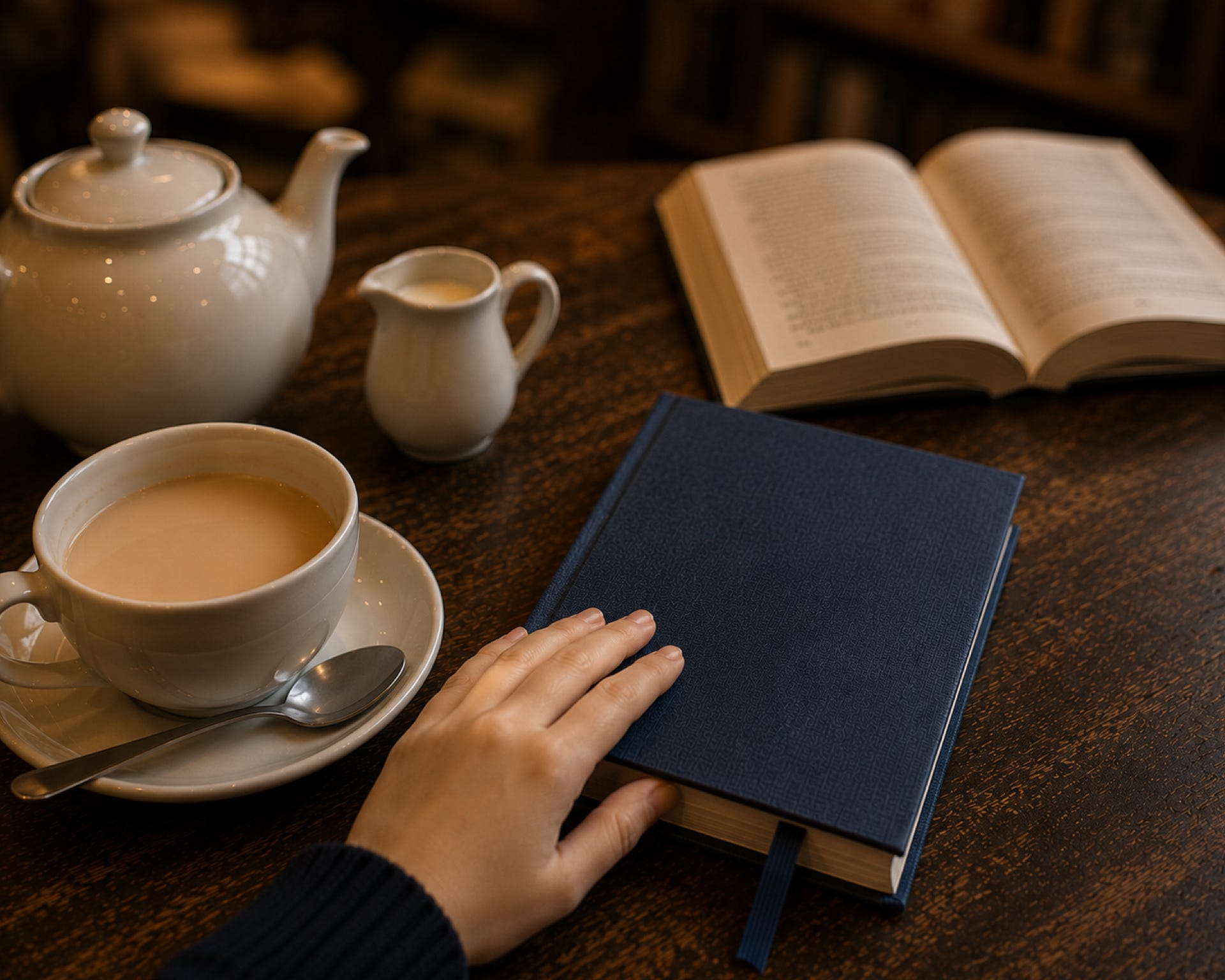
At 9:46 on Saturday morning, Anna changed her jumper.
At 9:49, she changed it back.
She stood in front of the bedroom mirror, looked at herself and felt ridiculous. Nobody was going to see her. That was, quite literally, the point.
“No descriptions of appearance,” she reminded her reflection.
Her reflection remained unconvinced. Anna pulled the first jumper over her head again.
This was absurd.
She was going to a bookshop. The same bookshop she had been going to every Saturday at almost exactly the same time for six years. Nothing about this morning was different. Except, potentially, everything.
She went downstairs. The remains of breakfast sat beside the sink: one plate, one mug, a teaspoon abandoned beside the kettle.
The house was quiet. It had taken Anna years to become accustomed to quiet. There had been a time when Saturday mornings had contained almost none of it. Doors opening and closing. Music from bedrooms. Somebody shouting from upstairs that they couldn’t find something they had definitely left somewhere obvious. Half-finished bowls of cereal. Wet towels. Requests for lifts presented as though they had been agreed several days earlier rather than invented thirty seconds before departure.
Mum, can you —
Mum, where’s —
Mum, are you going out?
Mum, can you take me —
For years, Saturdays had belonged to everybody else. Then, gradually, they hadn’t. Children grew. They spent years needing you so completely that sometimes you fantasised about drinking a cup of tea while it was still hot.
Then one day you did. And nobody interrupted.
Anna had discovered that there were forms of freedom that felt suspiciously like loss when they first arrived. She loved her children being grown. She loved hearing about work and trips and ridiculous dates and minor domestic catastrophes that no longer happened beneath her own roof. She loved watching them become people whose lives did not solely orbit hers. She had wanted that for them.
Still, there had been Saturdays, in the beginning, when the house had seemed to hold its breath.
The first time she went to Dog-Eared alone, she hadn’t intended to make a habit of it. She had been forty minutes early for something she could no longer remember and unwilling to go home in between. The faded green awning had offered shelter from rain.
That was all.
She had gone inside. Ordered tea. Found the little table beside the travel section. And stayed until it was time to go again.
Nobody asked anything of her. Nobody needed feeding. Nobody needed collecting. Nobody wanted to know where the spare batteries were. She read a few pages of a novel she later disliked and ate a slice of lemon drizzle cake she hadn’t intended to order. The following Saturday, she went back. Six years on, George had stopped asking whether she wanted tea and started regarding any deviation from her routine as evidence of a medical emergency.
The tea had become part of it too. Anna didn’t dislike coffee. She simply preferred tea. George had spent six years trying to convert her anyway, but the truth was considerably older than Dog-Eared.
Her Nanna had been particular about tea.
Not in the way of temperatures or steeping times or whether milk should go in first. Her rules had concerned people.
Coffee, according to Nanna, was what you gave someone who had popped in. Tea was what you made when you invited them to stay. Anna had never been entirely sure whether this was etiquette or emotional blackmail, but she had absorbed it anyway.
Somewhere along the way, tea had become less about thirst and more about stopping. Sitting down. Staying a while. Even, she supposed, when the person she had chosen to spend time with was herself.
Anna looked at the kitchen clock.
9:52.
Plenty of time. She rinsed her plate. Wiped the worktop. Straightened the tea towel. Looked at the clock again.
9:54.
There was no reason to leave yet. Dog-Eared was less than ten minutes away.
She picked up her bag. Then put it down. This was not nerves. Nerves implied expectation. Expectation implied she thought somebody might have taken the book.
She had spent the week refusing to think about that. Mostly successfully. Except on Sunday. And Monday evening. And briefly on Tuesday while brushing her teeth. Wednesday had been particularly bad.
By Thursday she had decided nobody had taken it and felt unexpectedly irritated by an imaginary stranger failing to participate in an experiment they did not know existed.
By Friday she had recovered her dignity.
Mostly.
She checked the time again.
9:57.
There were two possible outcomes. The book would still be sitting on the community shelf, wrapped in increasingly tired brown paper, and George would look at her with insufferable sympathy. Or it wouldn’t.
That was all.
She slipped her coat on. Then took it off again because she had forgotten to brush her teeth. Three minutes later, she was back downstairs.
10:02.
“Oh, for God’s sake.”
She grabbed her bag. At the front door, she stopped. There was still time. Not to be on time, exactly. But nearly. Her hand remained on the handle. If nobody had taken the book, arriving a few minutes later would not make it less untouched.
And if somebody had —
She didn’t finish the thought.
Instead she went back into the kitchen and checked whether she had switched off the hob. She hadn’t used the hob. Anna stared at it and then laughed.
“Pathetic.”
Her phone screen read 10:04.
She left.
At 10:08, Anna reached Dog-Eared. She pushed open the door beneath the faded green awning and hurried inside. The brass bell rang above her.
George looked towards the door. Then at Anna.
His eyes flicked to the clock.
She narrowed hers.
“Don’t.”
“I didn’t say anything.”
“You looked at the clock.”
“I often look at clocks.”
“Not like that.”
“Like what?”
“Judgementally.”
George considered this.
“You’re late.”
“I have never told you what time I arrive.”
“You’ve been arriving just after ten for six years.”
“That is deeply unsettling.”
“I work here.”
“So do stalkers.”
“Tea?”
“Please.”
Anna unbuttoned her coat. George reached beneath the counter for the white pot.
“Everything all right?”
“Why wouldn’t it be?”
“You’re late.”
“We’ve covered this.”
“You also appear to have walked here as though pursued.”
“I was in a hurry.”
“Because you were late.”
She gave him a look.
George smiled.
“Two teabags?”
“I’m reconsidering our friendship.”
“I’ll take that as yes.”
Anna turned away before he could see her smile.
And then she saw it.
For one moment, her brain failed to understand what she was looking at. The community shelf sat beside the window exactly as it always did.
Crime novels. Cookbooks. A battered celebrity autobiography. Three romances involving improbable amounts of exposed male torso. And between a gardening book and something called The Cornish Murder Club —
The Bridges of Madison County.
Unwrapped.
Anna stopped. George continued preparing her tea. She crossed the shop slowly.
There was no brown paper. No string. Only the familiar cream spine, creased almost white in places. Her copy. Back where she had asked for it to be returned.
She reached for it. Her fingers touched the cover. Somebody had taken it. Not merely picked it up. Taken it away. Opened it. And, presumably, finished it.
Her pulse shifted. She pulled the book from the shelf. The cream note was still inside the front cover. She checked immediately. It was folded exactly as she’d left it. She opened it.
Dear Stranger…
She didn’t read further.
Instead, she replaced the note and flicked to the first annotation she remembered clearly. It took less than a minute to find. Her handwriting sat in the margin.
This was where I stopped judging her and started understanding her.
And beneath it, in pencil she had never seen before:
Understanding someone doesn’t make what they do less selfish.
Anna stared.
“Oh.”
The word escaped before she could stop it. A woman browsing nearby glanced towards her. Anna lowered the book slightly.
“Sorry.”
The woman returned to the shelves. Anna read the response again.
Understanding someone doesn’t make what they do less selfish.
There was something unexpectedly thrilling about disagreement when it arrived in handwriting. Not a comment box. Not a message. Not some stranger on the internet explaining why she was objectively wrong.
Pencil.
On paper.
In her book.
She ran her thumb just below the sentence without touching the graphite.
They had read it. Really read it.
She turned several pages. Her own notes appeared first. Small fragments she knew almost by memory.
Oh, Francesca.
Then:
This made me angry the first time. It still does.
Nothing beneath either. She kept going.
Sometimes I think this is the saddest part of the whole book.
Underneath:
Why?
Anna stopped.
One word.
That was all.
Why?
She looked at the paragraph beside it. An ordinary domestic moment. Nothing dramatic. No great declaration. No rain. No impossible goodbye. Just Francesca moving through the familiar machinery of her life.
Anna had always thought those were the saddest parts. Not because the life itself was terrible. A terrible life could be recognised as terrible. There were doors out of things you could name.
The more dangerous kind of unhappiness, she had always thought, was the sort that looked perfectly acceptable from the outside.
A kitchen. A family. Responsibilities fulfilled.
Nothing broken enough to justify wanting something different.
She looked again at the pencil.
Why?
Because sometimes nothing has to be wrong for something to be missing.
The answer formed immediately. Anna reached automatically into her bag for a pen. Then stopped.
“No.”
This time George looked over.
“Talking to yourself?”
“Apparently.”
“Should I be concerned?”
“Only if I answer myself back.”
She slipped the pen back into her bag. The book wasn’t the journal. She couldn’t answer here.
Or perhaps she could.
He had.
He?
Anna looked at the handwriting again. She had no evidence of that whatsoever. Still, for now, he could be a he. The thought made her smile.
She turned another page.
Then another.
There were more.
Not many.
Enough.
His handwriting appeared between hers like another voice entering a room. Sometimes disagreeing. Sometimes asking. She found herself smiling at that too. Then she reached the note she had thought about most before giving the book away.
I don’t think loneliness excuses betrayal. I do think it explains why people sometimes become strangers to themselves.
Beneath it:
Explanations have a habit of becoming excuses when we want them badly enough.
Anna’s smile disappeared.
Then:
Someone still has to live with what you chose.
She read both sentences twice.
The café seemed to recede slightly around her.
Someone still has to live with what you chose.
For a moment she was no longer standing beside the community shelf. She was much younger.
Pregnant.
Listening to somebody tell her that recklessness was not the same thing as intention. That mistakes happened. That regret mattered. That love should matter more. She remembered how desperately she had wanted that to be true.
How much easier forgiveness sounded when people who had not been betrayed described it.
She had forgiven, eventually. Or something adjacent to forgiveness. Time had softened the event without rewriting it.
Years later, friendship had grown in places where romantic love had failed.
None of that meant nobody had lived with the choice.
She had.
For years.
Anna looked down at the stranger’s handwriting. They thought she was excusing Francesca.
Interesting.
They thought understanding meant absolution.
More interesting.
And that sentence —
Someone still has to live with what you chose.
That didn’t feel entirely like literary criticism.
She turned the page. Then another. Her fingers moved more slowly now. Near the end she found her final note.
Perhaps some love stories are not meant to become lives. Perhaps they exist only long enough to wake us up.
She had almost erased that one. It was too sentimental. Too revealing. Too close to something she wasn’t sure she believed anymore.
Beneath it, the stranger had written:
And what happens to everyone else when they do?
Anna exhaled.
“Well,” she whispered.
That was a fair question.
An irritating question.
Possibly the question.
She closed the book. For several seconds, she simply held it against her chest. Then she remembered where she was and immediately lowered it.
George placed her tea on her usual table. He didn’t call her over. He didn’t need to.
Anna looked towards him.
George looked back.
His expression was infuriatingly neutral.
She walked to the table and sat down. The book went beside the teapot. George returned to the counter.
Anna poured her tea.
Added milk.
Waited.
Nothing.
She took a sip.
George rearranged a stack of napkins.
She watched him.
He refused to look up.
Anna lasted twenty-three seconds.
“George.”
“Anna.”
She lowered her voice.
“Someone read it.”
George continued folding a napkin that did not need folding.
“So it would appear.”
“They wrote in it.”
“Vandalism. Terrible.”
“You’re enjoying this.”
“Immensely.”
She looked towards the community shelf again. Then back at him. There was a question sitting behind her teeth. She refused to ask it.
George polished the counter.
Anna opened the book again. Closed it and drank tea.
George continued existing in a deliberately irritating manner.
“Did they —”
She stopped.
George looked up.
“Did they what?”
“You know perfectly well.”
“I know many things.”
“You’re unbearable.”
“So I’ve been told.”
Anna glanced behind him. The highest shelf.
Order forms. A small ceramic teapot missing its lid. No blue journal.
She went still.
The space beneath the stack of forms was empty.
George followed her gaze.
Neither of them spoke.
Anna looked at him.
George raised one eyebrow.
“They asked?”
He picked up a cup.
“You told me not to tell you anything about them.”
“I didn’t ask anything about them.”
“You’re about to.”
“I am not.”
“You have that face.”
“What face?”
“The one you make immediately before asking questions you already know you shouldn’t.”
She sat back.
“That isn’t a face.”
“Six years, Anna.”
She hated when he used that as evidence. She wrapped both hands around her tea.
“So someone asked for it.”
George inspected the cup.
“Exact words.”
A small, involuntary flutter moved low in Anna’s stomach. She resented it immediately.
“The Saturday Journal?”
He looked at her.
“No. That weird blue notebook belonging to the person whose writing I found strangely compelling.”
Anna stared.
George grinned.
“Of course The Saturday Journal.”
“You’re an arse.”
“And yet you entrusted me with your romantic future.”
“It is not romantic.”
“Of course.”
“It isn’t.”
George returned the cup to the shelf.
“An experiment.”
“Yes.”
“In human connection.”
“Yes.”
“Between two anonymous strangers.”
“Yes.”
“One of whom has spent the last ten minutes reading the other’s handwriting with the expression of a woman who has discovered fire.”
Anna picked up her tea.
“I liked you better before you became observant.”
“I’ve always been observant.”
“I know. It’s very inconvenient.”
She drank.
George smiled and moved away to serve somebody else.
Anna looked at the empty shelf again. The journal was gone. Not misplaced. Not hidden somewhere else.
Gone.
Someone had read the book, her notes, reached the final page and felt curious about the person who had written them.
About her.
Anna had allowed for this possibility when she’d invented the whole ridiculous thing. She just hadn’t properly considered what it might feel like if it actually happened.
How much it might matter.
Her rules. Her ridiculous rules.
No names.
No descriptions.
Tell the truth.
Questions are welcome.
Do not ask to meet.
Seven days.
Be kind.
She had written them late on a Friday night at her kitchen table, half convinced nobody would ever read them. Now somebody had.
Anna looked down at the paperback. The stranger’s handwriting waited between the printed lines. She still knew almost nothing about them.
They finished books they didn’t agree with. They argued in margins. They disliked explanations that sounded too much like excuses. They wanted to know why she found ordinary sadness more affecting than dramatic heartbreak. They appeared to have complicated feelings about betrayal.
And they had been curious enough to ask for the journal.
It wasn’t much, but it felt like considerably more than a photograph on a dating app.
Anna took another sip of tea.
It had gone cold.
She drank it anyway.
She stayed longer than usual.
At eleven fifteen, having retrieved her current read from her handbag, she told herself she was finishing her chapter.
At eleven thirty-two, she ordered another pot of tea.
At twelve, George placed half a slice of lemon drizzle cake beside her without comment.
“I didn’t order this.”
“You look like you need stabilising.”
“I’m perfectly stable.”
“You’ve read the same page four times.”
Anna looked down.
She had.
“I was thinking.”
“Dangerous habit.”
“So I’ve heard.”
George smiled and returned to the counter.
Anna ate the cake. The Bridges of Madison County remained beside her. Every so often she opened it. Not to read. Just to look.
It was strange seeing another person’s handwriting inside something that had belonged to her for so long. Stranger still that she didn’t resent it.
The book had travelled through three houses. A marriage. A divorce.
Different shelves.
Different bedrooms.
Different versions of herself.
For years, its margins had belonged only to Anna. Now they didn’t. That should have bothered her. Instead it felt as though someone had opened a door she hadn’t realised she’d left unlocked.
At twelve twenty-seven, she packed both books into her bag.
George looked over.
“Taking it?”
“It’s mine.”
“I know.”
She paused.
“You knew?”
“You’ve brought it in here often enough.”
Anna frowned.
“You remember that?”
“Anna.”
“Six years.”
“Exactly.”
She slipped her coat on. At the door she stopped.
“George?”
He looked up.
A barrage of questions almost fell from her lips like coins from a split purse.
What did they look like?
Were they young?
Old?
Man?
Woman?
Did they seem nice?
Did they hesitate?
Did they smile?
Did they look disappointed?
Did they look curious?
She could have asked all of it.
George would almost certainly have refused. He understood the rules. But asking would have been cheating anyway. Not George. Herself. The whole point of the experiment. The fact that she wanted to know irritated her.
So instead she said:
“Don’t tell me anything.”
Something softened in his expression.
“I won’t.”
“Even if I ask.”
“That seems optimistic.”
“Promise.”
George considered her.
“Promise.”
Anna nodded.
She opened the door and the brass bell rang. Outside, the town carried on without the slightest awareness that anything had changed. People walked past carrying shopping bags. A bus sighed at the kerb.
Somebody pushed a pram through a puddle.
Anna stepped beneath the faded green awning and pulled her coat closed. She had spent six years slowly learning how to enjoy Saturdays that belonged entirely to her. She was good at it now. Very good. She travelled alone when she wanted to. Sat in cafés alone. Went to exhibitions and films and places she had once imagined required company. She had stopped postponing her own life until somebody arrived to share it.
That had taken time.
It had taken practice.
It had taken learning that being alone and being lonely were not the same thing.
Anna believed all of that.
Completely.
Still, somewhere, a stranger had a blue journal containing seven rules written in her handwriting. Perhaps they had opened it already. Perhaps they hadn’t. Perhaps they were reading those rules at this exact moment. Anna had absolutely no way of knowing.
And for the first time in a very long while, Saturday no longer felt entirely hers.
Anna smiled to herself and started walking home.
By half past three, Anna had almost succeeded in returning to normal.
Almost.
The Bridges of Madison County was back on the shelf in her sitting room. She had put it there without thinking, moved it somewhere else, then moved it back because the entire exercise was becoming embarrassing.
Her phone buzzed on the arm of the sofa.
The family group chat.
She opened it.
Sunday dinner?
Three seconds later:
At Mum’s?
Anna frowned.
She had not been consulted.
Another message appeared.
I can do 5ish
Then:
Can I bring washing 😂
Anna typed:
Interesting how this has become an invitation without me actually issuing one.
A reply arrived almost immediately.
So that’s a yes?
Then another.
What are we having?
Anna stared at the screen.
Audacity, apparently.
A laughing emoji.
Then:
Can we have roast potatoes?
Anna smiled despite herself.
There had been a time when feeding everyone had been an obligation so relentless she could remember standing in supermarkets feeling personally attacked by the question of what to cook. Now Sunday dinner happened less often.
Work. Partners. Plans. Lives of their own.
The fact that they still wanted to come home and empty her fridge was, she supposed, a privilege.
She typed:
Five. Bring wine. Nobody bring washing.
A pause.
Then:
Define washing
Anna put her phone face down.
Some things motherhood did not cure.
Across the room, The Bridges of Madison County sat where she had left it. Her eyes went to it automatically. She looked away.
The phone buzzed again.
Also can I bring someone?
Anna picked it up.
Someone?
Three dots appeared.
Disappeared.
Then reappeared.
A person. Don’t be weird.
Anna laughed.
I’m your mother. Weird is contractually required. Yes.
She set the phone down again.
For several minutes she sat without doing anything. Then she stood, crossed the room and picked up the book. Not to read. Just to put it somewhere sensible. That was all.
She opened it anyway.
Why?
One word.
Still there.
She closed the book.
“Ridiculous.”
This time there was nobody around to hear her answer herself back.
On Sunday morning, Anna stood barefoot on cold rock at Trevone and questioned every decision that had brought her there.
Martha was already halfway out of her clothes.
“Come on.”
“I am coming.”
“You’ve been saying that for five minutes.”
“I’m preparing psychologically.”
“You’re wearing a swimsuit under your clothes.”
“That proves nothing.”
Martha pulled off her jumper.
There were certain activities that sounded far more appealing when discussed somewhere warm. Wild swimming was one of them.
In theory, it was invigorating. Restorative. Good for the nervous system. In practice, it involved voluntarily removing most of your clothing beside the Atlantic and walking into water cold enough to make your ancestors reconsider evolution.
Anna unzipped her Dryrobe and smiled despite herself. The first time George had seen evidence of her wild-swimming on Instagram, he’d messaged almost immediately.
Dryrobe wanker.
Followed, moments later, by:
At least you’re not wearing Crocs too.
Naturally, Anna had responded with a photograph of the purple Crocs already on her feet.
George had been merciless.
You do know why Crocs have holes, right?
She’d known better than to ask.
So your dignity can seep out.
Anna looked down.
Purple Crocs.
“Still no regrets.”
“What?” Martha asked.
“Your brother is a prick.”
“This isn’t news. But let’s hear you justify it.”
“He called me a Dryrobe wanker.”
Martha looked at the Dryrobe. Then at the Crocs.
“He’s not wrong, though.”
Anna stared at her.
“I came here for friendship and emotional support.”
“You came here because I texted you three times and threatened to swim without you.”
“Yes, that too.”
Martha laughed and hopped out of her trackie bottoms.
Anna looked towards the sea pool.
The water was dark and glassy, almost perfectly still against the rocks. Even from where she stood, it looked cold.
Properly cold.
The sort of cold that made every sensible decision she had ever made seem briefly available to her again.
Martha followed her gaze.
“You’re stalling.”
“I’m assessing conditions.”
“You do this every week.”
“And every week the conditions remain unnecessarily wet.”
“You’ll love it in thirty seconds.”
“I’ll lose sensation in thirty seconds.”
“Same thing.”
Anna laughed.
They climbed down carefully.
The first touch of water around her ankles made her swear.
Her friend grinned.
“Graceful.”
“Shut up.”
Knees.
Thighs.
Waist.
Anna inhaled sharply.
“Oh, absolutely not.”
“You’re already in.”
“That is not the argument you think it is.”
Then she pushed away from the edge. Cold closed over her shoulders. For several seconds there was nothing else.
No school.
No dinner to cook.
No unanswered messages.
No book.
No blue journal.
Just breath.
Water.
Sky.
The shock of being completely inside her own body. That was what kept bringing her back. Not the cold. Not really.
The silence beneath it.
The way the cold demanded her full attention. You could not overthink in water that cold. You could only breathe.
They swam a few lengths of the pool before climbing out, laughing and swearing in equal measure. By the time Anna had wrapped herself in a towel, her hands were shaking.
Martha handed her a cup of something hot.
“Tea.”
Anna accepted it gratefully.
“See. This is friendship.”
“I thought friendship was dragging you into freezing water.”
“That’s abuse.”
“You came voluntarily.”
“Debatable.”
Steam rose from the cup. Anna wrapped both hands around it. Martha looked at her.
“You’re quiet.”
“I’m drinking.”
“That’s not an explanation.”
Anna smiled into the cup.
For one brief second she considered telling her.
About the book. The handwriting. The empty shelf. Someone asking for The Saturday Journal. It would have been easy. She would have understood the absurdity of it immediately. Probably demanded every detail. Probably asked questions Anna was already trying very hard not to ask herself.
She took another sip.
“Just tired.”
Martha studied her.
Anna waited.
Then, mercifully:
“School?”
“Among other crimes against humanity.”
“That bad?”
“Ask me again after half term.”
Martha laughed.
The moment passed. Anna looked towards the sea. She wasn’t hiding the journal. Not exactly. It simply felt too small and strange to explain yet. Too new. Telling someone would make it a story.
Anna wasn’t ready for it to become one.
By five fifteen, her kitchen was full. Coats hung over chair backs. A bottle of wine had appeared on the counter alongside two supermarket desserts despite Anna having specifically said she would make pudding.
There were shoes by the door that belonged to nobody when she asked.
“Who wants gravy?”
Everyone. Obviously.
Anna stood at the cooker while conversation moved around her in overlapping strands.
Work. Rent. Somebody’s manager. A car making a suspicious noise. A holiday being considered but not yet affordable.
The “person” one of her children had brought hovered politely at the edge of the kitchen, clearly unsure whether to sit down or offer to help. They chose the latter. Anna liked them immediately for that alone.
“Leave it,” she said.
“I don’t mind.”
“You’re a guest.”
“So are we,” one of her children called from the other room.
Anna looked towards the doorway.
“No, you’re a recurring expense.”
Laughter.
“Love you too.”
She smiled.
This was the version of noise she had missed when the house first became quiet. Not the logistics. Not the endless responsibility. This. People arriving because they wanted to. Leaving because they had homes of their own. Returning again anyway.
At some point after dinner, while everyone was arguing over whether the supermarket cheesecake counted as homemade if somebody had removed it from the box, one of them wandered into the sitting room.
“Mum?”
“What?”
“Is this the sad affair book?”
Anna looked up.
Her daughter was holding The Bridges of Madison County.
Something in Anna reacted before she could stop it.
“Careful.”
The room went quiet for half a second.
Her daughter raised an eyebrow.
“I’m holding a book, not an unexploded bomb.”
Anna stood and took it from her.
“I know.”
“You made me watch the film.”
“I did not make you.”
“You cried while she was making dinner.”
“That scene is devastating.”
“She was cooking.”
“I know.”
“Nothing had even happened.”
Anna looked at her.
“That’s the point.”
Her daughter laughed and went back to the kitchen.
Anna looked down at the book. For a second, she saw the stranger’s pencil beneath her own. She closed it and returned it to the shelf.
Again, not its usual place.
Monday morning arrived with fluorescent lighting and somebody crying in the corridor before registration. Anna had been working as a teaching assistant for long enough to know that neither thing was unusual.
She found the student sitting on the floor outside the tutor room, hood pulled up, arms folded tightly across their chest. A teacher stood nearby.
“They’re refusing to go in. Or remove their hoodie.”
Anna crouched a little distance away.
“Morning.”
No response.
The teacher sighed.
“They’ve got an assessment first period. They know that.”
Anna looked at the student. Their breathing was too quick. One leg bounced against the floor.
“Would you mind?” The teacher gestured towards the huddled student.
“Only, if I don’t get this register done in the first five minutes, I’ll have attendance on my back.”
“Sure, go. We’ll be in in a moment.”
The teacher left.
Anna waited.
She had learned years ago that silence was often more useful than questions.
After a while, she sat properly on the floor.
Her knees objected but she ignored them.
“Awful carpet,” she said.
Nothing.
“Whoever chose this colour had given up on joy.”
A tiny movement beneath the hood. Not quite a smile.
Progress.
Anna waited again.
Eventually:
“I can’t do it.”
The words were barely audible.
“The assessment?”
A nod.
“Okay.”
The student looked at her, apparently surprised.
“Do you know what’s going to happen if you get something wrong?”
No answer.
“Because I do.”
The student looked at her.
“You’ll get something wrong.”
Their eyes were wet.
“They’ll know I’m stupid.”
There it was. Not refusal. Not laziness. Not defiance. Fear.
Anna leaned back against the wall.
“I don’t think you’re stupid.”
“You have to say that.”
“I absolutely do not. You should hear some of the things I say in the staff room.”
A reluctant smile.
“Come on. We’ll go in together.”
“I can’t.”
“You don’t have to do all of it at once.”
The student looked up towards the classroom.
Anna waited.
Eventually, they stood.
So did she.
Her knees complained again.
“See?” she said. “Hardest part done.”
“That was just standing up.”
“Exactly. We’re flying.”
They walked into the classroom together.
Later, in the staff room, someone described the morning as another example of children being allowed to opt out whenever something made them uncomfortable.
Anna stirred her tea.
She loved her job. She loved the young people. She loved the moment when something finally clicked. The quiet victories nobody put on spreadsheets. The student who came in after three days absent. The child who trusted you enough to say I don’t understand instead of throwing the worksheet across the room. The one who stayed in the classroom for ten minutes longer than yesterday. She loved all of that.
The system was another matter.
Somewhere along the way, education seemed to have become increasingly determined to measure everything except the things that mattered. Attendance. Progress. Targets. Data. Interventions.
Numbers arranged into enough columns that adults could convince themselves a child had been understood.
Anna looked into her tea.
Explanations have a habit of becoming excuses when we want them badly enough.
The sentence arrived without invitation.
She stopped stirring.
Then another:
Someone still has to live with what you chose.
Anna thought about the student in the corridor. Understanding why they had refused the classroom did not mean allowing them never to enter one again. It meant knowing what you were actually asking them to overcome. There was a difference. A significant one.
She reached for her phone and stopped.
There was nowhere to send the thought.
Of course there wasn’t. She had designed it that way.
Anna sat back.
“Problem?”
A colleague looked at her over the rim of a mug.
“No.”
“You’ve got your thinking face on.”
“I do?”
“You do.”
Anna sighed.
Apparently everyone in her life had become observant.
By Tuesday, the answer had become a sentence. By Wednesday, Anna had rewritten it three times in her head. By Thursday, she was annoyed with herself for rewriting a response to a person who had not actually asked her anything in the journal yet.
The question had been written in the book. Technically, she could answer there. But that wasn’t the point anymore. The journal was. That distinction had become surprisingly important.
On Thursday evening she sat cross-legged on the sofa with a novel open in her lap and read the same paragraph twice. Then a third time.
She lowered the book. On the shelf opposite, The Bridges of Madison County waited.
“No.”
The house remained silent.
Anna frowned.
“I’m not having an argument with someone who isn’t here.”
She picked up her book again.
Her phone rang.
One of her children.
Anna answered.
“Hello?”
“Mum, quick question.”
“There is no such thing.”
“Do you still have my blue coat?”
And just like that, the stranger disappeared beneath the ordinary machinery of Anna’s life.
For a while.
Friday evening, she made tea. She read. She put washing away. She answered a message from a friend. She watched half of something on television and realised she had no idea what had happened.
At 9:38, she looked towards the clock.
Seven days. That had been her rule. Not because seven days had any particular significance. It had simply seemed long enough to think and short enough not to lose momentum. Now it felt unnecessarily punitive.
She wondered whether the journal was back at Dog-Eared.
Immediately, she corrected herself. That was irrelevant. If it was, George would tell her tomorrow. If it wasn’t, he wouldn’t. Simple.
Anna took her mug upstairs.
At 10:17 she got into bed. At 10:23 she checked her alarm. She never set an alarm on Saturdays. Anna stared at the screen. Then turned it off.
Some dignity remained.
At 9:54 on Saturday morning, George looked up as the brass bell rang.
Anna entered.
He looked at the clock. Then at her.
“Don’t.”
“I didn’t say anything.”
“You were going to.”
“I was thinking.”
“Dangerous habit.”
“So I’ve heard.”
George smiled.
Anna removed her coat with enormous composure.
“Tea?”
“Obviously.”
“Two teabags?”
“George.”
“Just checking.”
She carried her bag to the usual table beside the travel section.
Sat down.
Took out her book.
Opened it.
Read one sentence.
Then another.
She did not look towards the counter. This was important. She was here to read. As she was every Saturday. Nothing about today was different.
Behind the counter, cups clinked. The coffee grinder started. The bell rang twice. Someone ordered a flat white. Anna turned a page. She had no idea what she had just read. And then George appeared beside her table. He placed the white teapot down.
Then the cup.
Milk.
A teaspoon.
Anna looked up.
“Thank you.”
“You’re welcome.”
He didn’t move.
Anna looked at him. George reached beneath his arm.
Blue cloth.
For one second, neither of them spoke. Then he placed The Saturday Journal on the table.
Anna stared at it.
Seven days ago it had contained nothing but rules. Now the ribbon sat somewhere deeper between the pages. Something tightened beneath her ribs. Not fear exactly.
George looked at her.
Anna looked at the journal.
“Your tea,” he reminded her.
She glanced at the pot.
“Thank you.”
George smiled and walked away.
Anna placed one hand on the blue cover.
Then opened it.
The Saturday Journal continues next Saturday.